Previously Unknown 15th Century Text by Gutenberg Associates Discovered
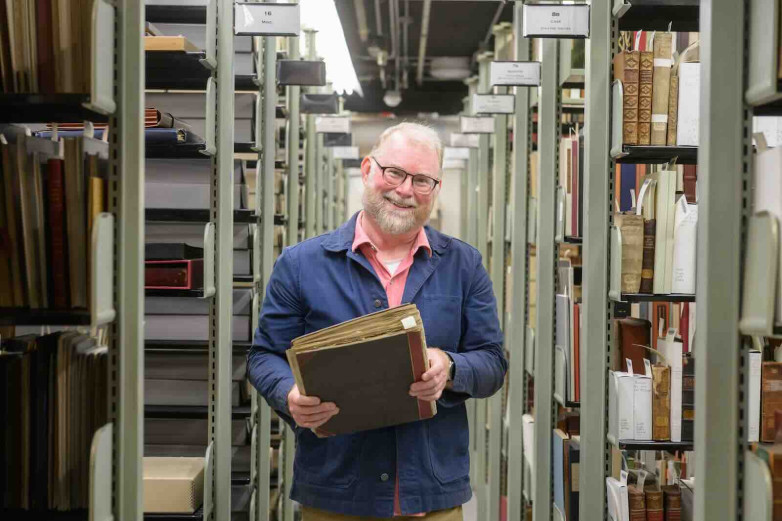
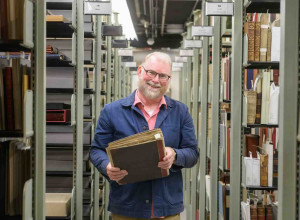
Eric Johnson-DeBaufre, Rare Books and Special Collections Librarian for the Watkinson Library at Trinity College, poses with a collection of scraps from the archives containing a page from an Aelius Donatus.



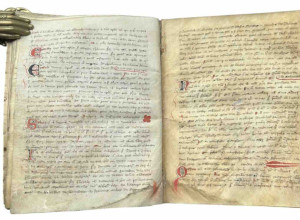
A page of printed text hidden for more than a century in an uncatalogued scrapbook at Trinity College's Watkinson Library in Hartford, Connecticut, has been identified as a previously unrecorded 15th century printing connected to the circle of Johannes Gutenberg.
It has been identified it as a leaf from the Latin grammar textbook Ars minor written by the 4th century Roman grammarian Donatus, and printed using type developed by Gutenberg associates Johann Fust and Peter Schöffer.
“Any new discovery of a book from this period, especially of an unrecorded book, one that we had no record of anywhere at all, is always a big event,” said Eric Johnson-DeBaufre, Rare Books and Special Collections Librarian at Watkinson Library. “And when it's one that's connected to Mainz, Germany, which is where printing in the West began, it's especially exciting. For a discovery like this to happen here in the United States is almost unheard of.”
Donatuses were among the first texts to be printed by Gutenberg and his associates as they offered both a dependable stream of income and a chance to test the quality of the types before their use in more ambitious projects such as the Gutenberg Bible.
According to Vincent E. Tomasso, associate professor and chair of Classical Studies at Trinity College, the text was essentially a classroom textbook: “The book that this leaf is from taught the parts of speech, so it’s kind of like our textbooks today.”
The Watkinson Donatus is unusual because it was printed on paper rather than vellum. It may have served as a proof sheet before the text was printed on its more durable final medium. The types used in the fragment derive from the first state of those used to print the famous Mainz Psalter in 1457, one of the landmark books of early European printing.
The fragment was discovered in a scrapbook devoted to pieces of binding waste collected by William Cowper Prime, founder of the art history department at Princeton University and the first vice president of the Metropolitan Museum of Art. Prime generously donated more than 40 scrapbooks, many containing original prints by artists such as Albrecht Dürer, Jost Amman, Lucas Cranach, and Rembrandt, as well as nearly 1,500 books printed in the 15th and 16th centuries to Watkinson Library in 1905.
“This scrapbook collection has sat in the Watkinson as a sort of hidden collection,” said Johnson-DeBaufre. “It has not been catalogued for the entire time that it has been with us, since 1905.”
Johnson-DeBaufre recognized the fragment's significance and made the initial identification of its type while reviewing the scrapbook collection, and its identification was subsequently confirmed by Princeton University's Paul Needham (Scheide Librarian Emeritus) and Eric White (Scheide Librarian and Assistant University Librarian for Special Collections, Rare Books, and Manuscripts).
“It's an important discovery for early book history,” said White. “The Trinity fragment represents a 15th century printing of a schoolbook that has never been seen before and was never expected to exist.”
Johnson-DeBaufre, Needham, and White are continuing their examination of the fragment and hope high-quality scans made at Princeton University will yield additional information about the date of its printing. They plan to publish their findings in a scholarly journal before making the fragment more broadly accessible through Trinity College's digital repository where it will be available to researchers around the world.